
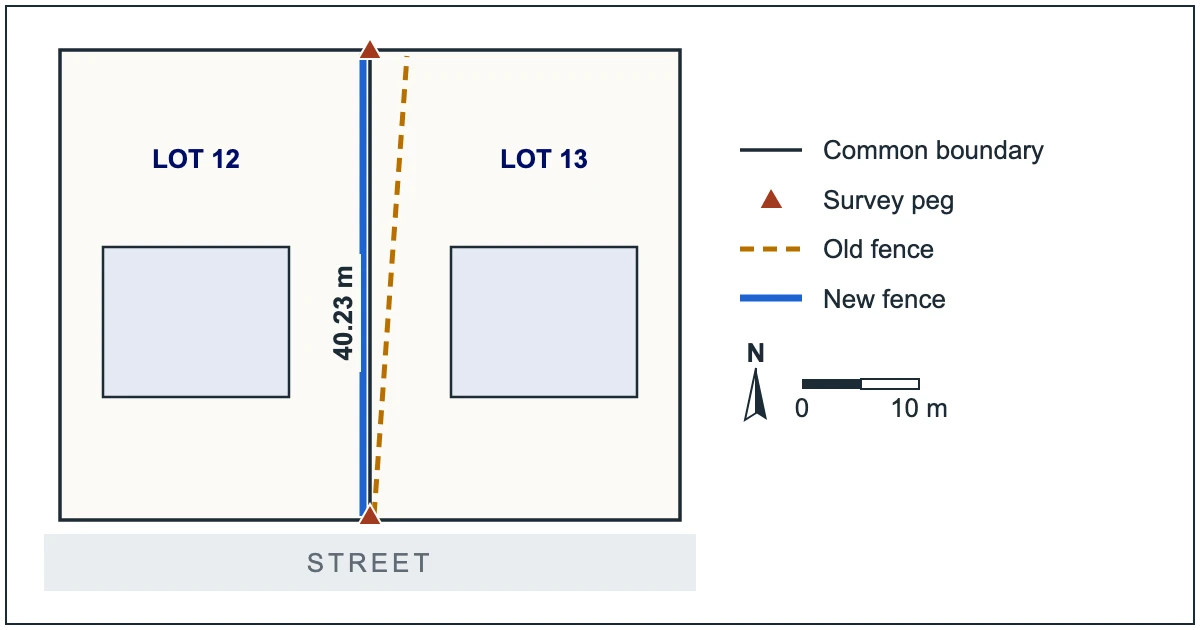
Under the Dividing Fences Act 1991 (NSW), you and your neighbour usually share the cost of a sufficient dividing fence equally. If you cannot agree on the work, you serve a written fencing notice, and after one month without agreement either of you can ask the NSW Civil and Administrative Tribunal (NCAT) or the Local Court for an order. The notice has to name the boundary line the fence will go on, so the process works best when both of you already agree where that line is.
This guide walks through the Act step by step. The Act is the same across NSW, so it applies in Newcastle, Lake Macquarie and everywhere else in the state. The guide shows where pegging the boundary fits, who pays for it, and what to do if the neighbour does not reply. It is general information, not legal advice.
Key takeaways
- Neighbours contribute in equal shares to a "sufficient" dividing fence. Whoever wants something better pays the extra.
- A fencing notice must state the boundary line, the type of fencing work and its estimated cost. There is no set form.
- Work done before the notice (unless it is urgent, or the Court or Tribunal allows a late notice), or before you agree or get an order, is not shared.
- If there is no agreement one month after the notice, either owner can apply to NCAT or the Local Court. The NCAT fee is $64, or $16 with a concession, as at 1 July 2026.
- "Fencing work" under the Act includes surveying the land along the boundary. A survey can be shared if you agree it with your neighbour in writing before it is done, list it in the fencing notice and wait for agreement or an order before booking it, or use the section 18 procedure.
- If you disagree about where the boundary is, section 18 of the Act sets out how a registered surveyor defines it, and who pays.
How the Dividing Fences Act works, in five steps
The Act sets out a short sequence, and you only go as far as you need to.
- Talk to your neighbour. Agree on the line, the kind of fence, the cost and the split. Put the agreement in writing.
- Settle the line. If either of you is unsure where the boundary is, agree in writing to have it pegged and how you will split the cost, before anything is ordered or pulled down. If you cannot agree on the cost, list the survey in your fencing notice and wait for agreement or an order before booking it. If you disagree about where the line is, use the section 18 boundary notice.
- Serve a fencing notice under section 11 if you cannot agree, or if you want a formal record.
- Wait one month. If you reach agreement, build to it.
- Apply for a fencing order to NCAT or the Local Court if there is still no agreement.
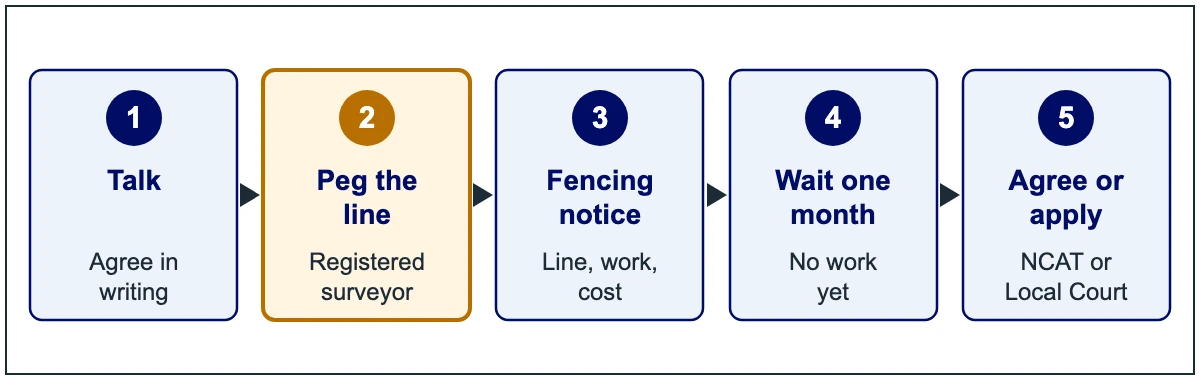
The order matters for your money. Section 11 says an owner is not liable to contribute to fencing work carried out before the notice is served, or after it but before the owners agree or a court or NCAT decides. The exceptions to the first rule are urgent repairs and a late notice allowed by the Court or Tribunal. Pulling the old fence down first and asking for half later can leave you paying the whole cost.
Who pays for a dividing fence in NSW
Section 7 makes adjoining owners liable to contribute in equal proportions to fencing work for a dividing fence "of a standard not greater than the standard for a sufficient dividing fence". An owner who wants more than that pays for the extent to which the work exceeds it.
What counts as sufficient is not a fixed list. If it goes to NCAT or the Local Court, section 4 has them consider all the circumstances, including:
- the existing fence, if there is one
- how the two properties are used
- privacy and other concerns of both owners
- the kind of fence usual in the area
- any council policy on dividing fences and any planning instrument for the land.
Some costs are not split equally. If one owner, or someone on their land with permission, damages the fence through a negligent or deliberate act, section 8 can make that owner liable for up to the whole cost of restoring it. Legal Aid NSW notes that the owner of a pool usually pays for the part of the fence that is the pool barrier. Section 25 says the Act does not apply to the Crown or to council land kept as a public reserve or park, and Legal Aid NSW says public authorities such as councils, Housing NSW and public schools have no legal responsibility to share the cost.
Before anyone digs post holes, Legal Aid NSW says you or your contractor must lodge a free enquiry with Before You Dig Australia.
Settle the boundary before the notice
A fencing notice must specify "the boundary line on which the fencing work is proposed to be carried out". An old fence is not always on that line. Fences get rebuilt a little to one side, follow a garden bed, or wander around a tree. If you serve a notice that describes the old fence as the boundary and the neighbour thinks otherwise, the disagreement is now about land, not palings.
Pegging the boundary first means both of you are looking at the same marks on the ground when you talk about cost. It also gives you evidence NCAT suggests you gather. Its dividing fences page lists a "current survey of boundary line (if available)" among the documents to gather, and section 14 lets NCAT or the Court make an order fixing "the boundary or line on which the fencing work is to be carried out".
Our licensed land surveyors work from the legal title information, the deposited plans and the survey marks nearby, then mark the boundary with survey pegs so the fence can be built in the right place. You can read more about having the boundary pegged before fencing. If you need a written report on where existing structures sit against the title boundary, that is an identification survey report.
If you and your neighbour disagree about the line: section 18
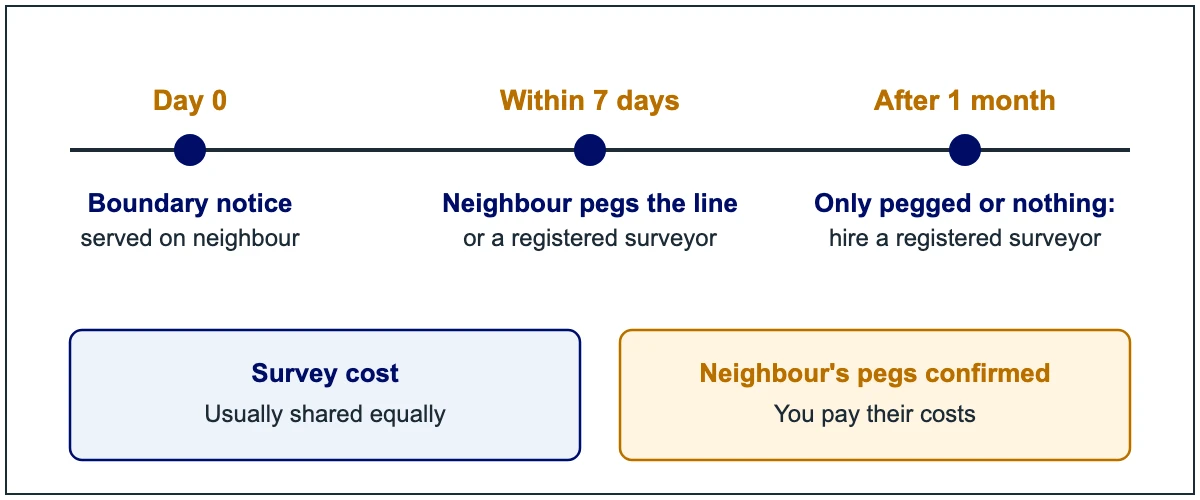
When adjoining owners do not agree on where the common boundary is for fencing work, section 18 sets out a procedure:
- Boundary notice. Either owner gives the other written notice that they intend to have the common boundary defined by a registered surveyor. There is no set form. Legal Aid NSW publishes a sample boundary notice.
- Seven days to respond. Within 7 days of being served, the other owner can either mark the line with pegs, if satisfied where it is, or employ a registered surveyor to define it. Either way they must tell you in writing.
- If they only pegged it, or did nothing. If, within one month of your notice, the other owner has only pegged the line or has not had it defined by a registered surveyor, you may have a registered surveyor define it.
A registered surveyor here means a surveyor registered under the Surveying and Spatial Information Act 2002 (NSW). Our licensed land surveyors are registered surveyors.
Who pays for the survey
The Act gives two routes, and both usually end in equal shares.
- As fencing work. The definition of "fencing work" in section 3 includes "the surveying or preparation of land" along or on either side of the common boundary for the fence, so it can be part of the cost you share under section 7. Section 11 does not share work done before the notice, or after it but before agreement or an order. So agree the survey and the split with your neighbour in writing before it is done, or list it in the fencing notice with the fence and wait for agreement or an order before booking it. A survey you order alone beforehand stays your cost.
- Under section 18. When a registered surveyor is engaged under the boundary notice procedure, "all reasonable expenses are to be paid in equal shares". The exception: if the surveyor finds the line in the same position as the pegs your neighbour placed, equal shares do not apply and your neighbour can recover their costs from you.
That exception is worth knowing. If your neighbour replies by pegging the line and you are not sure they are wrong, talk to them before you engage a surveyor: if the survey confirms their pegs, their costs fall on you.
Residential boundary surveys in Newcastle typically start from $800 to $1,500 on our guide pricing, depending on the size of the lot, the terrain and the survey marks nearby.
Replacing a fence with your neighbour? Send us the address and a short note about the fence. Our licensed land surveyors will peg the boundary so you and your neighbour are working from the same marked line before the notice goes out. If you want to share the survey cost, agree it with your neighbour first.
GET A FREE BOUNDARY PEGGING QUOTE CALL (02) 4003 6416
On the form, choose Boundary Survey. Rated 5.0 on Google from 4 reviews.
What the fencing notice must say
Section 11 sets out three things a notice must specify, and allows a fourth. Legal Aid NSW's step by step guide to preparing a fencing notice adds practical detail and two sample notices.
| Item | What to write |
|---|---|
| The line | The boundary line the work is on, or another line if building on the boundary is impracticable (s 11(2)(a)) |
| The work | The type of fencing work: length, height and materials (s 11(2)(b); Legal Aid NSW) |
| The cost | The estimated cost of the work. Attach a written quote (s 11(2)(c); Legal Aid NSW) |
| The split | Equal shares unless you propose otherwise, in which case state the proportions (s 11(3)) |
| The details | That it is a notice under section 11, both addresses, who will do the work, and the start and finish dates (Legal Aid NSW) |
Serve it on the owner, not a tenant on an ordinary lease (a tenant with 5 or more years left on the lease counts as an owner under the Act), by handing it over or posting it to their usual or last known address (section 21). Keep a copy and note the date.
If there is no agreement after a month
Section 12 lets either owner apply to NCAT or the Local Court for an order once one month has passed since the notice was served without agreement.
NCAT. Dividing fences applications go to NCAT's Consumer and Commercial Division, and NCAT says most people represent themselves. Dividing fences matters are first listed for conciliation and hearing. The application fee for a claim of not more than $10,000, or no amount, is $64, or $16 for a concession card holder, under NCAT's schedule as at 1 July 2026. Attach the fencing notice, the quote, photos and any survey of the boundary. NCAT's dividing fences orders page lists the orders it can make: the line the fence goes on, the work, the shares, who builds which part, the timing, compensation for loss of land, or that no fence is needed.
Mediation. The Act still mentions Community Justice Centres, but the NSW Department of Communities and Justice says that from 1 July 2025 its mediation is no longer available for disputes other than those referred by NSW courts or involving incorporated associations. At NCAT, conciliation happens as part of the first listing.
Council. City of Newcastle says it "has no role in fencing disputes as this is a civil matter between landowners". Check with your council, City of Newcastle or Lake Macquarie, about approvals for the fence itself, for example a fence on a retaining wall.
If an agreement or order sets no time for the work, section 15 gives three months. If the other owner does not do their part, you can carry out the work as agreed or ordered and recover their share.
Frequently asked questions
Can my neighbour replace the fence without my permission?
The Act deals with who pays, not with permission. To make you contribute, they need your agreement, or a fencing notice and then an agreement or an order. Under section 11, you are not liable for work done before the notice, or after it but before agreement or an order, unless it was urgent. Legal Aid NSW says that going onto a neighbour's property to do fencing work without permission is trespass, unless the work is urgent or there is an agreement or a court or NCAT order.
Is a retaining wall a dividing fence?
Usually not. The Act's definition of fence excludes a retaining wall, except a foundation or support needed for the fence itself. Legal Aid NSW notes the shared cost can include a retaining wall that supports or maintains the fence.
The old fence is not on the boundary. Does that matter?
It can. A notice must name the boundary line, and NCAT can order where the fence goes. Section 14 also says a fence placed off the boundary by an order does not by itself give either owner the land on their side. Having the boundary pegged before you replace the fence avoids building the new one in the old, wrong spot.
What if the fence is damaged and needs urgent repair?
Section 9 lets you do urgent work without a notice if it is impracticable to serve one first. Your neighbour is liable for half the cost, or more if section 8 applies because they damaged it negligently or deliberately, and can ask NCAT or the Court to review it within one month of the work being completed, or later if the Court or Tribunal allows.
Who do I contact about a boundary fence dispute in NSW?
Start with your neighbour. If you cannot agree, serve a fencing notice, and after one month either of you can apply to NCAT or the Local Court. Since 1 July 2025, Community Justice Centres no longer mediate disputes that people refer themselves, and City of Newcastle says it has no role in fencing disputes. If the disagreement is about where the line is, agree with your neighbour to have the boundary pegged and share the cost, or use the section 18 boundary notice.
How much does pegging the boundary cost?
Residential boundary surveys in Newcastle typically start from $800 to $1,500 on our guide pricing, depending on the lot, the terrain and the survey marks nearby. A survey for the fence can be a shared cost if you agree it with your neighbour in writing before it is done, list it in the fencing notice and wait for agreement or an order, or use the section 18 procedure. Send us the address for a free quote.
Before you serve a fencing notice
- Talk to your neighbour first and agree in writing if you can.
- If either of you is unsure where the boundary is, agree in writing to have it pegged and how you will share the cost, or use the section 18 boundary notice.
- Get a written quote for the fence.
- Write the notice with the line, the work, the estimated cost and the split, and serve it on the owner.
- Wait one month before applying to NCAT or the Local Court, and do not start work you want shared until you agree or have an order.
City Surveyors Newcastle provides land surveys across Newcastle and the Hunter Region.
Agree on the line, then the fence. Tell us the address and where the fence runs. We will send you a free quote first, then peg the boundary when you are ready.
GET A FREE BOUNDARY PEGGING QUOTE CALL (02) 4003 6416
On the form, choose Boundary Survey. Rated 5.0 on Google from 4 reviews.
Sources checked 18 November 2026: Dividing Fences Act 1991 (NSW); NCAT dividing fences and its fees and charges schedule as at 1 July 2026; Legal Aid NSW pages on boundaries, rights and obligations, fencing notices and its fences FAQs; NSW Department of Communities and Justice, Community Justice Centres; City of Newcastle, fences guide. General information only, not legal advice.